How-to guides
How to co-term enterprise contracts
October 21, 2026
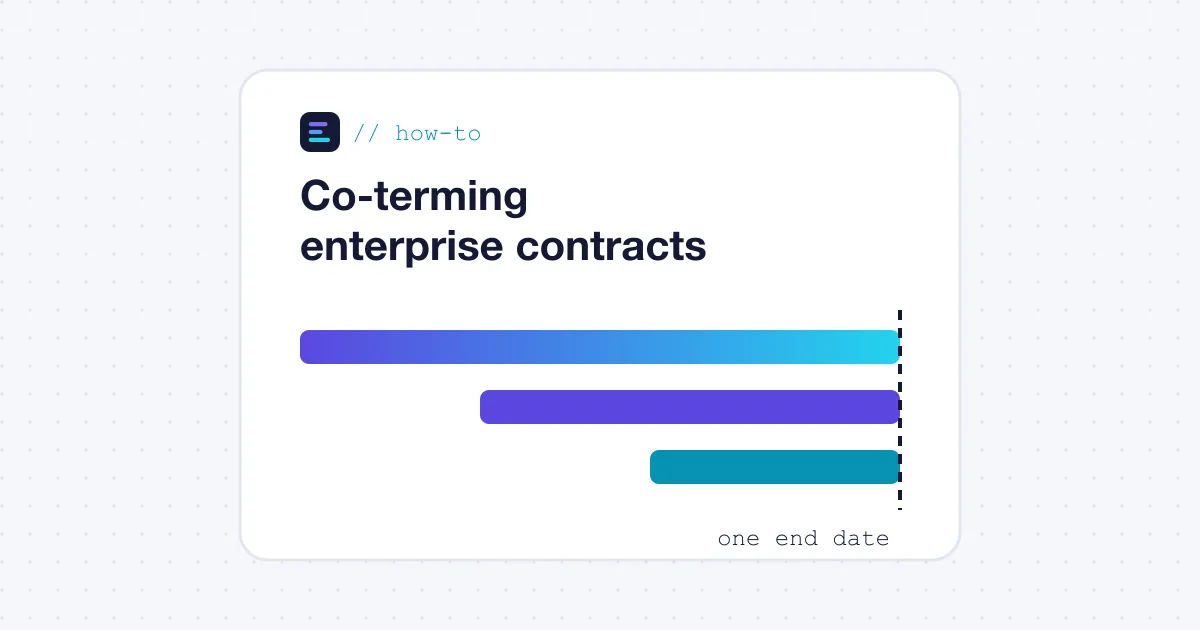
To co-term an enterprise contract, every add-on bought mid-term is given the same end date as the main contract and priced for the remaining months only, so that the whole account renews once, on a single date, with one renewal quote. In practice this means quoting the add-on as an amendment to the existing contract rather than as a new subscription, prorating its first charge, and letting it follow the contract’s ramp and renewal terms. A quote-to-cash platform that handles co-terming, amendments, ramps and automatic renewals on the same contract record does this without manual date math.
Why co-terming matters
Without co-terming, a three-year enterprise deal with four mid-term expansions ends up as five subscriptions with five end dates. Each one triggers its own renewal, its own invoice cadence and its own negotiation. Sales loses leverage, finance sends invoices the customer’s procurement team cannot match to a purchase order, and ARR reporting has to stitch the pieces back together.
Co-terming gives you:
- One renewal date per account, and one renewal conversation.
- One invoice schedule, aligned with the customer’s PO and budget cycle.
- A clean ARR history, where each add-on shows as expansion on the same contract.
How it works
Co-terming has three moving parts.
1. The amendment. The add-on is quoted against the live contract. The quote inherits the contract’s end date, billing frequency, payment terms and, often, its discount level. When signed, it amends the contract rather than creating a parallel one.
2. The prorated first charge. If the main contract is billed annually in advance, the add-on’s first invoice covers only the period from its start date to the next billing date. From then on it is billed with the rest of the contract.
3. Ramps and renewal. On a ramped deal, the add-on may or may not follow the ramp. If the contract has a price step-up in year 2, the amendment has to say whether the add-on’s price steps up too. At renewal, the add-on is included in the renewal quote at its current price, plus any uplift the contract defines.
A worked example
A made-up example, for illustration only.
- Main contract: 3 years, starting January 1, 2026, ending December 31, 2028.
- Platform: $120,000 per year, billed annually in advance.
- Ramp: year 1 at $120,000, year 2 at $140,000, year 3 at $160,000.
On May 1, 2026, the customer adds a module priced at $24,000 per year, co-termed to December 31, 2028.
| Invoice | Period | Amount |
|---|---|---|
| Add-on, prorated first charge | May 1 to Dec 31, 2026 (8 of 12 months) | $24,000 x 8/12 = $16,000 |
| Year 2 renewal of the full contract | Jan 1 to Dec 31, 2027 | $140,000 + $24,000 = $164,000 |
| Year 3 | Jan 1 to Dec 31, 2028 | $160,000 + $24,000 = $184,000 |
ARR moves from $120,000 to $144,000 on May 1, 2026, then to $164,000 on January 1, 2027 when the ramp steps up. If the add-on had been sold as a separate 12-month subscription, it would renew on April 30, 2027, out of sync with the contract, and the year 2 invoice would not match the customer’s budget line.
If the contract says add-ons follow the ramp, the module’s price would step up as well (for example to $28,000 in year 2). That choice belongs in the amendment, not in someone’s memory at renewal time.
Common pitfalls
Add-ons created as new subscriptions. The most common failure. The billing system has no link between the add-on and the main contract, so the end dates drift and the renewal process has to find the orphans.
Proration calculated by hand. Finance computes the first charge in a spreadsheet and enters a manual invoice line. It works once, then breaks on the next amendment. See how to handle proration on hybrid plans for the mechanics.
Ramp terms not applied to add-ons. The contract steps up in year 2 but the add-on stays flat, or the reverse, because the amendment did not specify it.
Auto-renewal ignoring amendments. If the renewal is generated from the original order instead of the amended contract, the add-ons disappear from the renewal quote.
Different billing frequencies. An add-on billed monthly on a contract billed annually cannot be co-termed cleanly. Align the frequency at quote time.
What to ask a vendor
- Can a mid-term add-on be quoted as an amendment that inherits the contract end date automatically?
- Is the first charge prorated to the next billing date without manual entry?
- Can the amendment specify whether the add-on follows the contract’s ramp?
- Does the renewal quote include every amendment at its current price, with the contract’s uplift?
- Does ARR show the add-on as expansion on the same contract, on the right date?
- Can several amendments stack on one contract and still produce one invoice per billing period?
Which quote-to-cash platforms document it
The table lists the platforms that document both co-terming and contract amendments, in score order. 15 of the 44 platforms we score document both. Co-terming on its own is documented by 18, amendments by 36. Ask about co-terming explicitly: a platform can document amendments without it. For the rest of the lifecycle, 24 document ramped, multi-year deals and 31 document automatic renewals.
| # | Platform | Score | Co-terming | Amendments |
|---|---|---|---|---|
| 2 | Maxio | 80.4 | Supported | Supported |
| 3 | Nue | 80 | Supported | Core strength |
| 5 | LedgerUp | 78.7 | Supported | Supported |
| 7 | Younium | 76.6 | Supported | Supported |
| 8 | Sequence | 76.4 | Supported | Core strength |
| 10 | Chargebee | 74.3 | Supported | Supported |
| 12 | Zuora | 73.5 | Supported | Core strength |
| 13 | Tabs | 71.2 | Supported | Supported |
| 14 | Salesbricks | 71.2 | Supported | Core strength |
| 17 | DealHub | 65.9 | Supported | Supported |
Top 10 of the 15 platforms that document all of these capabilities, by score.
The ranking on co-terming alone is at best quote-to-cash software for co-terming. For multi-year deals with step-ups, see best quote-to-cash software for ramped and multi-year deals. The levels in the table are defined on the scoring criteria page.
FAQ
What does co-terming mean in SaaS contracts?
Co-terming means aligning the end date of a product or add-on bought mid-contract with the end date of the main contract. The add-on is priced for the remaining term only, and everything renews together on one date.
How is a co-termed add-on priced?
The first charge is prorated from the add-on’s start date to the contract’s next billing date. After that, it is billed with the rest of the contract at its full periodic price, following the ramp if the amendment says so.
Should every add-on be co-termed?
For enterprise contracts billed annually, almost always, because one renewal date keeps procurement and forecasting simple. The exception is a short pilot or a one-off service, which can run on its own term and end without renewal.
Was this guide useful?
Get the next how-to guide and the scorecard updates by email.
Scorecard updates only. Unsubscribe at any time. See our privacy policy.